Serengeti Great Migration Safari Guide
You hear the noise long before you see the dirt cloud rising above the acacia trees. It is a low, rolling vibration that sits right in your chest, built from thousands of grunts, bleats, and the steady thud of hooves striking sunbaked earth. Experiencing the great migration serengeti is not a passive holiday where you sit back with binoculars and casually check species off a paper checklist. It is loud, messy, smelly, and completely indifferent to human schedules.
Over 1.3 million blue wildebeest, roughly 250,000 plains zebras, and several hundred thousand gazelles run this endless circuit between Tanzania and Kenya every year. Tourists arrive expecting a neat, synchronized nature documentary unfolding across two hours. The reality on the ground is far wilder, driven entirely by shifting rainfall, instinct, and raw survival. This guide covers how the movement actually works across the seasons, where to put yourself along the route, and how to avoid the expensive logistical mistakes many travelers make when booking serengeti migration safaris.
Book your serengeti safari tours experience:
The Annual Rhythm: Following the Great Migration Serengeti Loop
Most travelers assume the migration is a single summer event where animals sprint across a river. That river crossing is merely five weeks out of a 365-day circular trek. The herds never stop walking. There is no start date, no finish line, and zero respect for national park borders or tour group schedules. If drought hits early, the animals march weeks ahead of historical averages. If unseasonal showers soak the south, they turn right around and retrace sixty miles overnight.
From December through March, the wide grasslands of the southern plains become home to the herd. This is the calving window. In an astonishing biological surge, around 8,000 calves drop each day over a two-week span in February. The grass here grows on nutrient-rich volcanic soil produced by volcanoes in the Ngorongoro Conservation Area, giving lactating mothers the phosphorus and calcium they need. It is calm, open, and intensely violent, because every big cat in East Africa shows up to hunt young animals that can barely stand on wobbly knees.
Come April and May, the heavy rains sweep across Tanzania. The southern plains turn muddy and depleted, pushing the wildebeest northwest toward the central valleys and the Western Corridor. This stretch of the serengeti animal migration is lush, wet, and quiet. Roads become rivers of slick clay that swallow Land Cruisers to their axles, meaning very few tourists ever see the massive columns snaking past the Seronera Valley toward the Grumeti River.
By late June, the drying landscape pulls the herd toward the permanent waters of the Mara River in the far north. They linger around the northern border through October, bouncing back and forth across the border into Kenya depending on local downpours. Once November brings the brief short rains, the entire mass turns southward again, racing across eastern valleys to reach the greening southern plains before Christmas.
| Months | Serengeti Region | Primary Wildlife Event | Travel Conditions |
|---|---|---|---|
| January - March | Southern Serengeti & Ndutu | Mass calving; intense predator-prey interaction | Dry to light rain; open off-road driving permitted |
| April - May | Central Seronera & Western Corridor | Herds moving northwest; heavy rutting season begins | Heavy rainfall; muddy tracks; low tourist density |
| June - July | Grumeti & Western Corridor | First major river crossings; giant crocodile ambushes | Drying roads; rising temperatures; moderate crowds |
| August - October | Northern Serengeti (Kogatende) | Dramatic Mara River crossings back and forth | Dusty, warm, dry; peak visitor numbers |
| November - December | Eastern Serengeti & Lobo | Rapid southbound transit to reach new green grass | Short rains; greening landscape; spreading herds |
Note: Rainfall dictates every single step of this route. If rain arrives three weeks late in the south, the herd stays put, so never book a safari assuming animals will hit a specific coordinate on a fixed date.
River Crossings: The Chaos of the Mara and Grumeti
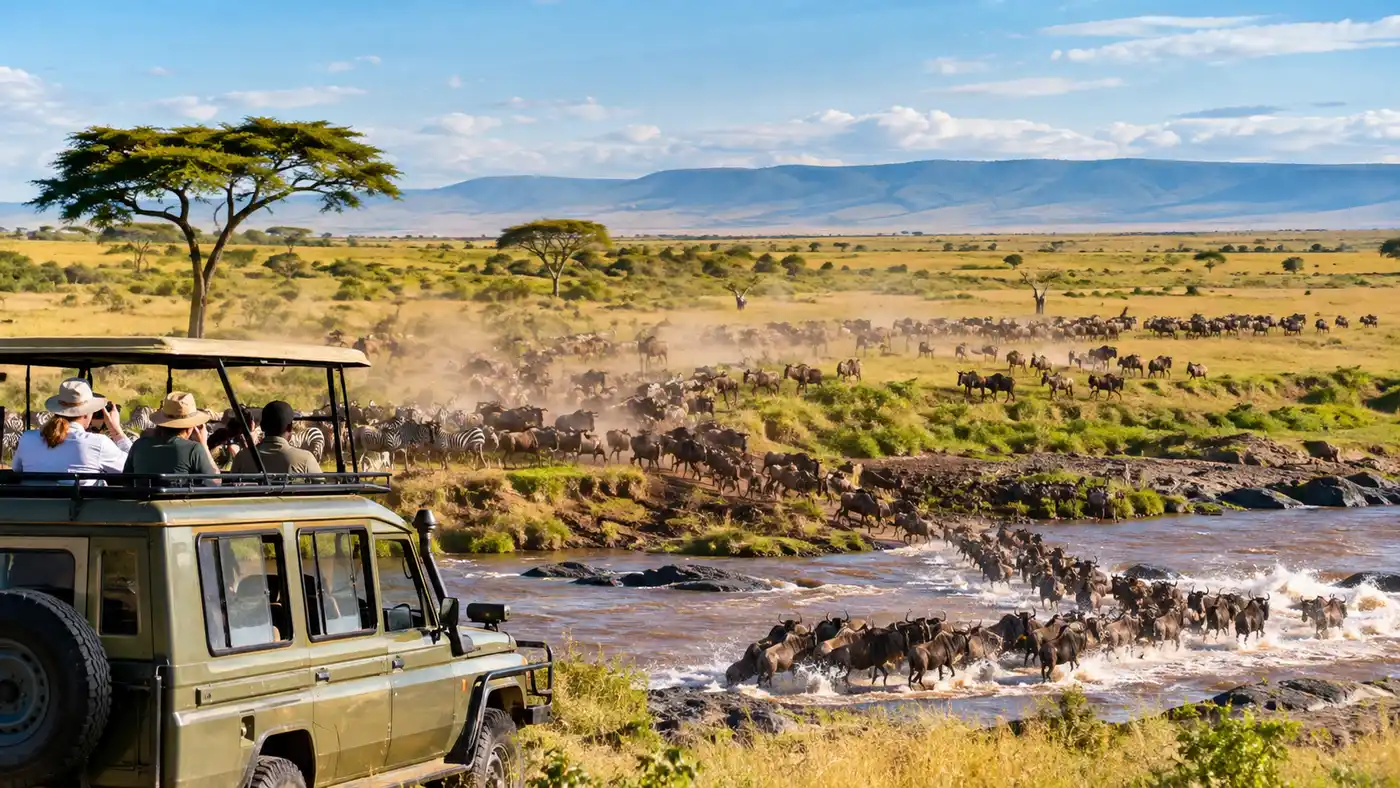
Nothing on earth matches the sensory overload of a Mara River crossing during the peak tanzania serengeti migration. You sit in an open-sided vehicle for five hours under a blistering midday sun, engine off, waiting near Crossing Point 4. A cluster of three hundred wildebeest gathers on the southern bluff, peering at the churning brown water below. They hesitate. One steps forward, gets spooked by an egret, and the entire mass stampedes back up the hill. You sigh, adjust your hat, and drink more warm water. Safari guides call this the waiting game, and it tests the patience of even seasoned travelers.
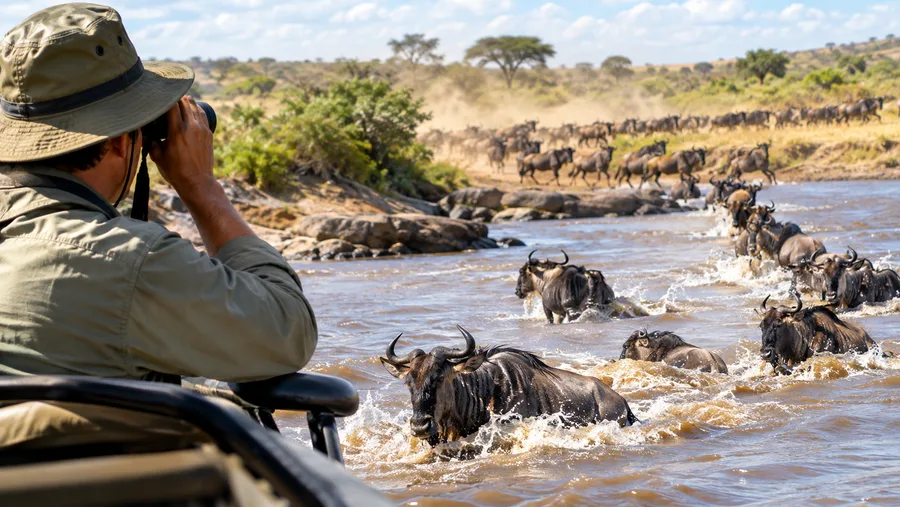
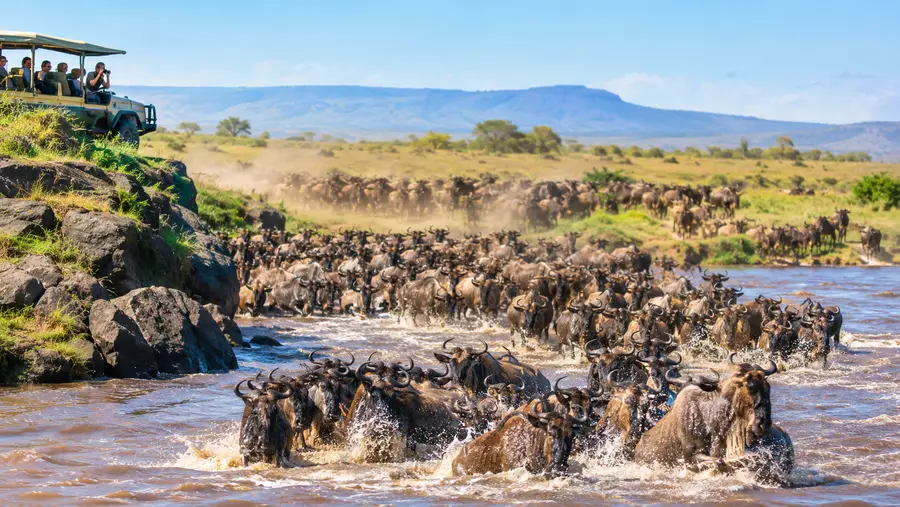
Then, without warning, a single zebra plunges off a six-foot dirt bank into the river. Within thirty seconds, five thousand animals throw themselves off the ledge in absolute panic. Water churns white. The air fills with a musky smell of wet hide and mud. Nile crocodiles - some measuring fourteen feet and weighing over a thousand pounds - glide effortlessly out of deep eddies. It is brutal, loud, and breathtakingly fast. Some calves are swept away by currents; others dodge snapping jaws and clamber up slippery boulders on the opposing bank.
The Grumeti River crossing, which happens earlier around late June or early July, offers a very different atmosphere. The river itself is narrower and broken into pools and marshy channels rather than a wide torrent. The crossings here are less cliff-dive drama and more tense, muddy slogs through deep pools where massive crocs have waited months for food. I prefer the Grumeti simply because the crowds are a fraction of what gathers in Kogatende.
Around the Mara River, vehicle congestion can turn frustrating. During August, sixty or seventy safari trucks might line a single stretch of bank. Experienced Tanzanian driver-guides communicate constantly via radio, trying to hold vehicles back behind designated markers so the skittish animals do not abandon the crossing. When drivers ignore these rules, the herd scatters, ruining the sighting for everyone.
Calving Season: The Best Time for Serengeti Safari Action in the South
While the crossings get the documentary airtime, my personal vote for the best time to visit serengeti national park tanzania is mid-February. Head to the southern plains around Lake Ndutu, where the park blends into the Ngorongoro Conservation Area. The grass here is short, green, and dotted with wild yellow flowers. You can see thirty miles in any direction without a hill in the way.
During these weeks, the sheer density of life is staggering. Everywhere you look, wildebeest mothers are giving birth. A calf drops, licks clean, and stumbles to its feet in seven minutes. Fifteen minutes later, it runs fast enough to keep pace with the herd. This biological marvel is necessary because the plains are swarming with predators. To learn more about the predators shadowing these herds, take a look at our Serengeti Wildlife Guide: Animals and Big Cats for breakdown details on lion prides and cheetah hunting habits.
Lions patrol the perimeter of the nursery herds, hunting in broad daylight because food is everywhere. Cheetahs use termite mounds and fallen trees as launching pads to sprint down yearlings across flat ground. Spotted hyenas work in relentless packs, trotting steadily until they isolate a straggler. It can be hard to watch, honestly, especially when a spotted hyena grabs a newborn minutes after delivery. Nature does not operate with human sentimentality, and this landscape is living proof of that contract.
Ndutu also gives guides an advantage they lack in the central or northern park: off-road driving is permitted in designated sectors. When a cheetah initiates a stalk three hundred yards out, your guide can slowly follow without being trapped on a gravel loop road. That freedom of movement transforms the entire photography experience.
Pro tip: Bring a sturdy dust cover or simple dry bag for your camera gear during calving season; fine volcanic ash on the southern plains penetrates loose zipper teeth and ruins lens barrels quickly.
Book your serengeti safari tours experience:
Choosing Serengeti Migration Safaris: Mobile Camps vs Permanent Lodges
Picking accommodation for the serengeti wildlife migration requires an honest assessment of your comfort threshold. Fixed luxury lodges offer infinity pools, spa facilities, air conditioning, and stone walls. They also do not move. If you book a stone lodge twelve months ahead in the western corridor, and the rains pause, leaving the migration seventy miles south in Seronera, you will spend eight exhausting hours every day bouncing on corrugated gravel tracks just trying to find the herds.
Semi-permanent mobile tented camps solve this problem. These are not budget pup tents where you sleep on rocky ground. They are high-end canvas structures with proper wooden beds, flush toilets, hot bucket showers hoisted by camp staff, and private verandahs. These camps move two to three times a year, following the expected path of the herds. If you are weighing the logistics between luxury options and standard camps, exploring Where to Stay in Serengeti: Lodges and Tented Camps will help you align your travel style with the right setup.
- Mobile tented camps: place you directly in the path of the animals so you wake up to zebras grazing outside your canvas wall.
- Permanent central lodges: provide year-round luxury and reliable resident wildlife, though they require longer drives to reach seasonal migration hotspots.
- Northern luxury villas: offer incredible cliffside views above the Mara River, ideal for travelers who want crossing access without sacrificing private plunge pools.
- Public budget campsites: keep costs down significantly, though basic facilities and shared long-drop toilets require serious camping resilience.
There is a distinct magic to sitting around a bush campfire at night, listening to lions roaring through the dark, knowing only a thin layer of canvas separates your bed from the African wilderness. Generators shut off by 10:00 pm, leaving you with absolute silence broken only by the night sounds of the savannah.
Logistics and Costs: Planning Serengeti Great Migration Tours
Planning a trip around the the great migration serengeti tanzania takes careful budget management and realistic schedule expectations. The park is roughly the size of Northern Ireland, and getting around it takes time. Driving from the entry gate at Naabi Hill up to the Mara River at Kogatende eats up eight to ten hours of brutal washboard roads. If your budget allows, booking a bush flight on an internal puddle jumper saves your back and buys you an entire day of game viewing.
A bush flight landing on a dirt strip like Seronera or Kogatende introduces you to the park from above, showing the true scale of the wildebeest lines cutting through the grass. Flights carry strict luggage limits, usually 15 kilograms (33 pounds) per passenger in soft-sided duffel bags, meaning your hard-shell suitcases must stay behind in storage at your Arusha hotel.
- Season selection: book nine to twelve months in advance if targeting the July to September Mara crossings, as northern river camps have limited bed counts.
- Vehicle choice: verify your operator uses custom four-wheel-drive extended Land Cruisers with pop-up roofs, charging ports, and built-in coolers.
- Park fees: budget for mandatory conservation fees, concession fees, and transit permits, which add up to several hundred dollars per person over a five-day circuit.
- Tipping funds: carry crisp, recent US dollar bills printed after 2009 for tipping camp crews and driver-guides, who work incredibly long hours.
Safaris are not cheap, and trying to cut corners on guide quality is the fastest way to ruin a trip. A great guide knows animal behavior, anticipates herd movements before they happen, and spots a leopard sleeping in a sausage tree from four hundred yards away. For a comprehensive financial breakdown of permits, fuel, and lodging, consult our Serengeti Safari Cost and Budgeting Guide before booking your tickets.
Frequently Asked Questions about great migration serengeti
What is the best time for serengeti safari to see river crossings?
The optimal window for Mara River crossings runs from late July through early October in the northern Serengeti. Grumeti crossings occur earlier, typically between late May and early July in the Western Corridor.
Can I see the migration in the Serengeti all year round?
Yes, the herds live within the greater Serengeti ecosystem 365 days a year. While parts of the herd cross into Kenya's Maasai Mara between August and October, substantial groups remain on the Tanzanian side throughout the entire calendar year.
How long should I spend on a Serengeti migration tour?
Plan for at least four full days inside the national park. Distances are vast, and animal movements are unpredictable, so spending less time risks missing the large concentrations if the herds shift overnight.
Is the calving season worth seeing compared to river crossings?
Calving season in February is extraordinary and often preferred by experienced safari travelers. You witness thousands of births daily, broad-daylight hunts by big cats, and far fewer tourist vehicles than at the northern river crossings.
Quick Reference
- Over 1.5 million migratory animals on the move
- 8,000 wildebeest calves born daily in February
- Mara River crossings peak August to September
- 4WD vehicles with experienced guides are essential
- Advance booking required 9-12 months out
Book your serengeti safari tours experience:
The Bottom Line
Standing on the edge of the savannah while thousands of hooves shake the ground changes the way you view the natural world. It is raw, uncensored, and humbling in a way modern city living makes you forget. Plan carefully, remain flexible when the weather scrambles your schedule, and trust your guide when they tell you to sit still and wait. The herds have made this walk for hundreds of thousands of years, and watching even a single day of their journey is worth every bump on the road.
Read more about serengeti safari tours.